Agent for Farmers 07507 772620
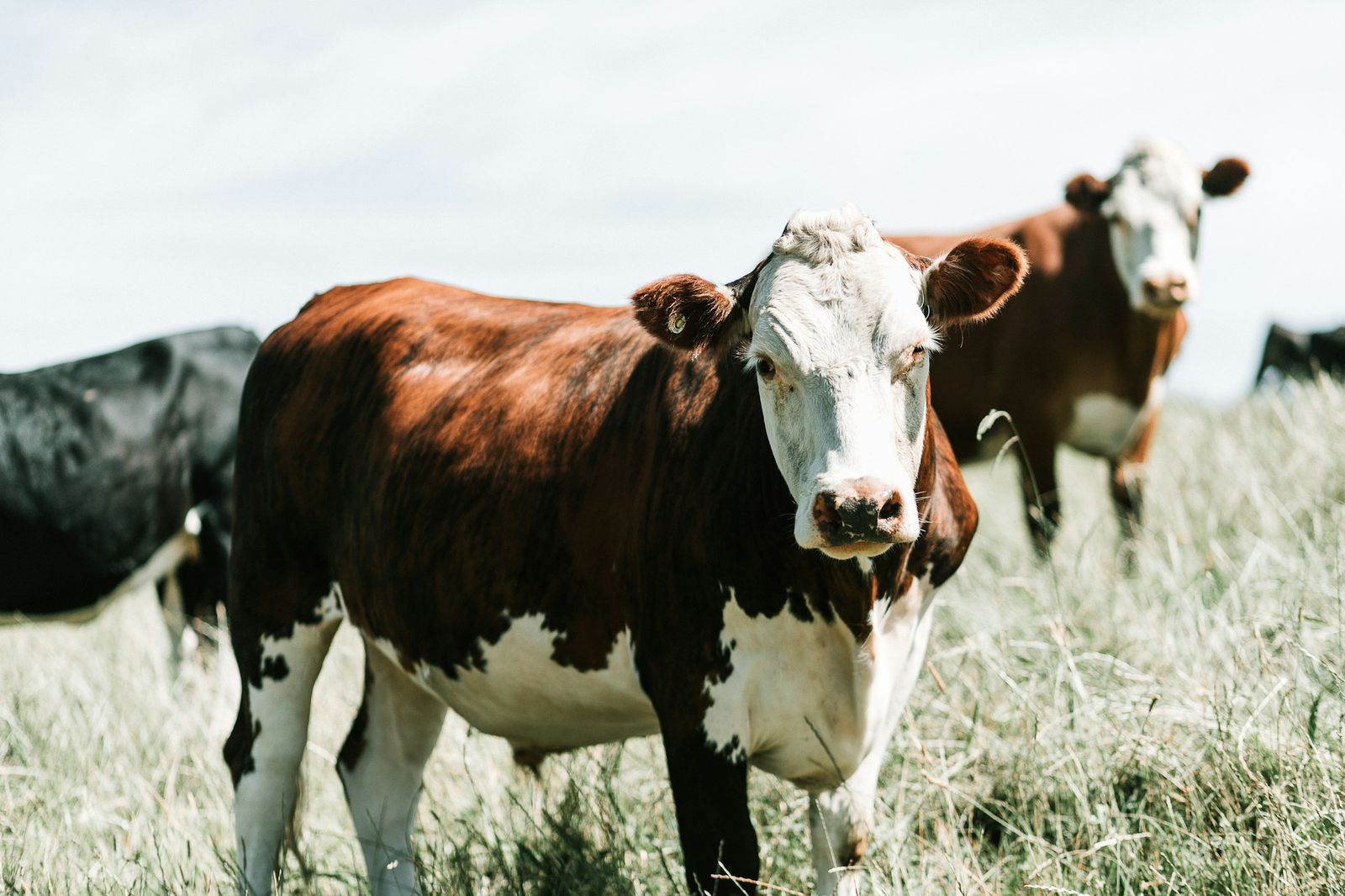
Hereford cattle at grass, one cow looking at the camera

Focus on Farming · a free guide

What AI can do for your farm office

AI won't farm for you, but it can take the office off your back. A plain guide for farmers in England.

By Stanley Young · about 10 minutes to read

Section 1A morning in 2031

It's half past six and the kettle's on. You say, out loud, "Morning. What's come in?" The voice that answers knows your farm: every field, every shed, every scheme you're in, and every letter you've had this year.

"A letter came from the milk buyer overnight about next year's standards. Two of the changes touch you, and I've put them side by side with what you do now. The vet's test is booked for the week after next. I've found the records the vet will want: two in your email, one in Dropbox and the last in the folder on your computer."

"The paperwork for the spring assessment is in good order. One certificate runs out in February, worth a look when you've got a moment. And after last night's rain, the two fields by the river might be worth walking before anything goes on them."

You ask it to draft a reply to the buyer and to remind you about the certificate in January. Then you take your tea out to the yard.

None of this needs new science. You can talk to an AI assistant with your voice today, on the phone in your pocket. What's missing on most farms is the part that makes it useful: an assistant that knows your farm. This guide is about building that, and why it's worth starting now.

And before you ask: your files stay with you, and nothing you share trains anyone's AI unless you let it. Section 6 explains how.

Section 2Why this matters now

Farming in England is under pressure from several directions at once. Minette Batters' Farming Profitability Review, published in December 2025, found profit squeezed by rising input costs, tight margins, labour shortages and uncertainty as direct payments are phased out. She concluded there is no single fix, and among her 57 recommendations were less unnecessary paperwork and better use of data.

The price you're paid is the part you control least. When the campaign group Sustain traced the price of a £2.50 pack of cheddar in 2022, the dairy farmer carried £1.48 of the cost and made well under a penny of profit on it. The figures will have moved since, but most farmers will recognise the shape.

There's a bigger picture too. By value, the UK produced 60% of the food it ate in 2025, down from 65% the year before. That's mostly a price effect, not less food grown: imports got dearer, so they make up a bigger share of the bill. Around half the feed and 70% of the fertiliser British farms use comes from abroad.

Nobody official calls this a crisis, but the risks are rising. Farms that know their own numbers will handle the shocks better.

Government is moving in the same direction. Defra's Farming Roadmap 2050, published in July 2026, plans to replace several separate government services with a single digital farming account. That's one front door for dealing with government. This guide is about having the same for everything else on the farm.

You can't set the supermarket's price. You can decide how much of your week goes on paperwork, and how often a missing record costs you money.

  • 57recommendations in the Batters review, including less unnecessary paperwork
  • £1.48of a £2.50 pack of cheddar carried by the dairy farmer, for well under a penny of profit (2022)
  • 60%of the food the UK ate in 2025 was produced here, by value
  • 70%of the fertiliser British farms use comes from abroad

Section 3The real problem: your farm's information is everywhere

Think about where your farm's information lives today. Some is in the diary by the back door and some in a pile on the kitchen table. Some is in your email, on government websites behind a login, in the vet's system, in the agronomist's reports and in the milk buyer's app. Some is in the assurance folder, and a good deal of it is in your head.

None of it is missing. It's scattered, and it only has to come together when someone asks for it: an assessor, a buyer, an inspector, or you, trying to make a decision.

That's what makes farm office work so wearing. A Swiss study of 811 farmers, published in 2024, found they rated administration as more of a burden than their farm work as a whole, even though it took only a few hours a week.

In Britain, one survey found one dairy farmer in five spending more than 15 hours a week on it, with assurance schemes the biggest load. The hours vary from farm to farm. What doesn't vary is that the paperwork lands at the worst times, and nobody went into farming to do it.

Section 4What AI actually is, and what it isn't

AI, in the sense that matters here, is software you talk to in ordinary language. It reads, sorts, drafts, compares and reminds. You can ask it a question the way you'd ask a well-informed neighbour, or ask it to go through a folder of documents and tell you what's there.

What it does

  • Reads letters, emails and documents
  • Sorts and finds records
  • Drafts replies and summaries
  • Compares what you hold with what's asked
  • Reminds you what's coming up

What it can't do

  • Farm
  • Judge an animal or walk a field
  • Replace your vet, agronomist or land agent
  • Make your decisions for you

It works for you, and the decisions stay yours.

Be wary of big promises. Headlines about 40% more yield usually come from people selling something, not from independent studies. The honest case for AI on most farms today is plainer: fewer hours lost to the office, fewer things missed, and better use of information you already have.

You won't be the first to try it. A McKinsey survey of 5,500 farmers in ten countries, published this year, found 17% already using generative AI, the kind of assistant this guide is about, for farm work, though only 4% were paying for it. Most are trying it out, the way you might.

Section 5The farm office is about to change

For most of farming's history, the farm office has run on filing. Paper comes in and goes in a drawer or a folder, and when someone asks for it, somebody goes looking. The work is in the finding.

That is starting to change from both ends. Government is moving its services into one online account. Buyers and assurance schemes already run their own websites and ask for more evidence each year.

The direction is clear even where the dates aren't. The people you answer to will expect evidence when they ask for it, and fewer of them will wait while you look.

At the same time, the tools for answering have arrived. An AI assistant can read a letter, find last spring's records and pull together what an assessor wants, in minutes. The office stops running on filing and starts running on asking.

That changes the job in the farm office, not who does it. The person who used to spend evenings finding things becomes the person who runs the assistant: deciding what it does, checking what it produces, and putting their name to what goes out. Their knowledge of how the farm works matters more than ever, because it's what the assistant learns from.

Over the next five years, the advantage will go to farms that can answer a question about their own farm quickly and with evidence, and that make decisions on their own figures instead of from memory. Size has little to do with it.

The office stops running on filing and starts running on asking.

Section 6Your data should stay yours

As AI arrives on farms, plenty of companies will want your records inside their system: uploaded, copied and kept on their servers. It's worth thinking hard before you agree. Once your records live in someone else's system, leaving gets harder every year.

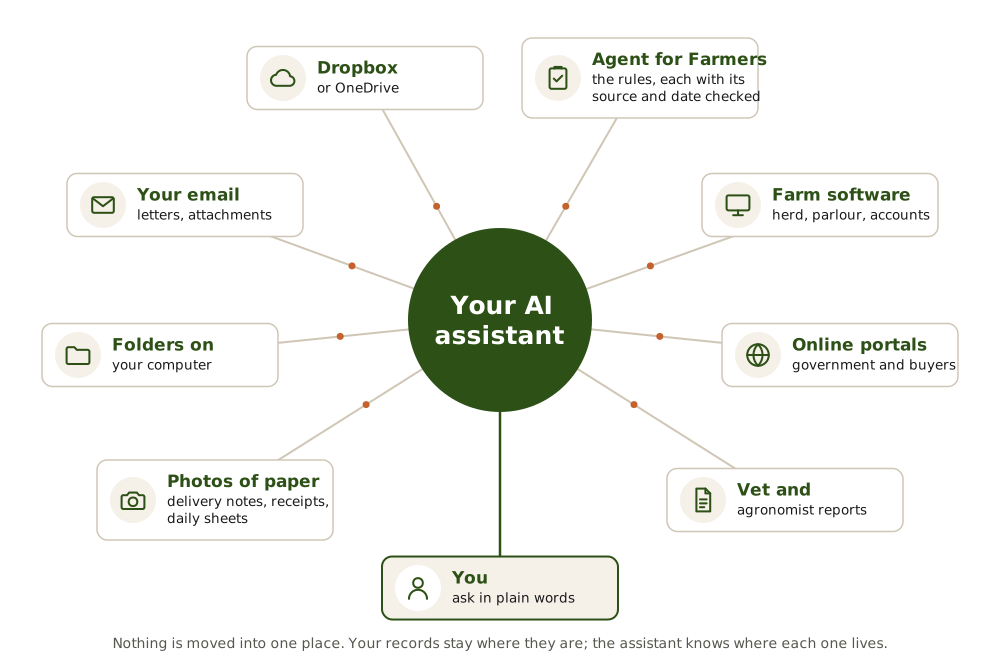
There's a better way to work. Your information doesn't need to move. Email can stay in your email, documents in Dropbox or OneDrive, spreadsheets in the folders on your computer, and your farm software can carry on as it is.

The assistant learns where each of those lives and reads them where they are. You point it at them once, and from then on it finds what it needs wherever it sits. The paperwork stays scattered; your view of it doesn't.

Diagram: you ask your AI assistant in plain words, and it reads each source where it is: your email, Dropbox or OneDrive, folders on your computer, photos of paper, farm software, online portals, vet and agronomist reports, and Agent for Farmers for the rules. Nothing is moved into one place.
Tap the diagram to see it larger.

Loose paper still needs a home. A photo of a delivery note or a receipt can go into one farm inbox folder, and the assistant does the sorting. Nothing you've already built gets thrown away, and nothing overwrites your records.

Will it train its AI on my farm's information?

AI has had a lot of bad press, and this is the question most farmers ask first. With Claude, the assistant we use, only if you let it.

On Claude's free and personal plans there's a setting that lets your chats be used to improve it, which you can switch off and change at any time. Its business plans for teams aren't covered by that setting.

Four questions to ask any AI company, ours included

  1. Who owns my data?
  2. Who can see it?
  3. Where is it kept?
  4. Can I take it with me if I leave?

If the answers aren't plain, that tells you something.

Agent for Farmers was built to give plain answers. It holds the rules and never sees your files, and your files stay where you keep them. The full promise is in our data promise.

Section 7Train it once, and it works your way

Anyone who has trained a new pair of hands on the farm knows how it goes. You show them how the place runs, how you like things written, which buyer is fussy about what, and what can wait until Friday. After a while they know your farm nearly as well as you do.

An AI assistant learns the same way, only faster. The farm profile questions are its first lesson. After that, every time you correct it ("too formal", "the vet is Sarah, not the practice", "always copy in my son"), it keeps a note and does it that way next time.

Whoever runs your farm office does the training, and it works for them. They decide what it does, check what it produces, and put their name to what goes out.

Then comes the part that saves the hours. Because it knows your farm and how you work, it can turn your scattered records into the things you actually have to produce:

  • the evidence for an assessment, with anything missing listed;
  • a reply to the buyer, in your words, with the right figures in it;
  • this month's medicine records, tidied for the vet's visit;
  • a summary of a long contract or scheme letter, with the parts that touch your farm marked;
  • notes for the land agent before a meeting.

Each takes minutes rather than an evening, and the more it does for you, the better it gets.

A fellow farmer's experience

There was a time nobody could imagine mobile phones and email being second nature in a farm business. AI is going the same way; I use it every single day. It writes my weekly production reports for our integrator, drafts emails, and reads and summarises the long documents from the solicitor and other advisers so I don't have to.

I've stopped filing altogether. Everything comes in by email to one inbox, hard copies get scanned in, and the assistant files and names the lot. It makes preparing for audits remarkably straightforward.

Best of all, after a twelve-month battle with the energy regulator, the assistant's persistence, attention to detail and a full audit of our records got over £20,000 of withheld funds released. My advice to any farmer is simple: have a go. Start with an easy task you'd normally do yourself, and see how quickly your assistant does it.

A Herefordshire farmer

It also gets sharper every season. Once it can reach all your records, patterns start to show: where costs creep up, which jobs keep slipping, and what last year's timings tell you about this year's.

Input spend by field, set against what each field produced. Medicine use, set against the health of the herd or flock. Daily records compared with the weeks and seasons before.

None of this needs a dashboard you'll never open. You ask in plain words, and the answer draws on evidence you already own.

We won't promise you a yield figure or a percentage saving. Decisions made on your own records beat decisions made from memory at the end of a long day, and that's enough.
Section 8Where do I start?

Three steps, and you can take the first one this week.

  1. This week: try it on one real job

    Download a free AI assistant on your phone, such as Claude or ChatGPT, and give it one real piece of farm paperwork. It's worth checking its privacy settings before you share anything sensitive. You might try:

    "Here's a photo of a letter from my milk buyer. What's changed, and what does it mean for me?"

    "Turn these notes into a tidy record of what we did in the top field this month."

    "Draft a polite reply to this email from the agronomist."

  2. This month: list where your information lives

    Take a sheet of paper and write down every place your farm's information sits today: paper, email, websites, apps, the vet, the agronomist, the buyer, your own head. Most people are surprised by how long the list gets. That list is exactly what you point the assistant at.

    Download the printable checklist

  3. When you're ready: become a pilot farm

    Agent for Farmers is open to pilot farms only, free while you're on the pilot, and Stanley will come and set you up if you need him to.

    Become a pilot farm

    Or ring 07507 772620.

Keep a copy

The whole guide as a printable PDF, to read later or pass on to whoever runs your farm office. No sign-up needed.

Download the guide (PDF)

About Agent for Farmers

Agent for Farmers helps farms in England keep their paperwork in order. It checks a farm's records against the rules that apply to it, tells you what's due, and gets your records ready before the assessor arrives. Three farms in Herefordshire are using it now.

Stanley Young spent 25 years in financial markets, much of it moving a whole industry from paper to automated systems. He lives in Herefordshire and started Agent for Farmers to bring the same thinking to the farm office.

Sources

  • Farming Profitability Review 2025 (Minette Batters), via Defra, December 2025
  • Sustain, Unpicking Food Prices, December 2022
  • Defra, Agriculture in the UK, food self-sufficiency figures for 2025, via Farmers Weekly
  • National Audit Office, Resilience of the food supply chain to disruptions, 4 September 2026
  • Agricultural Industries Confederation figures on feed and fertiliser imports, reported by Farmers Weekly, September 2026
  • Defra, Farming Roadmap 2050: Growing England's Future, 3 July 2026
  • Mack et al., administrative workload of farmers in Switzerland, Data in Brief 58, 2024
  • SUM-IT Farmer Insights Survey 2023
  • McKinsey, Global Farmer Insights 2026

Agent for Farmers is an AI tool. It is not a regulated agronomy, legal or financial adviser. Figures checked 27 October 2026.